Tweed Nails: The Woven Texture for Late Winter
Short broken dashes in layered neutrals, woven like cloth and finished matte: tweed nails, the tailored texture for the last weeks of winter.

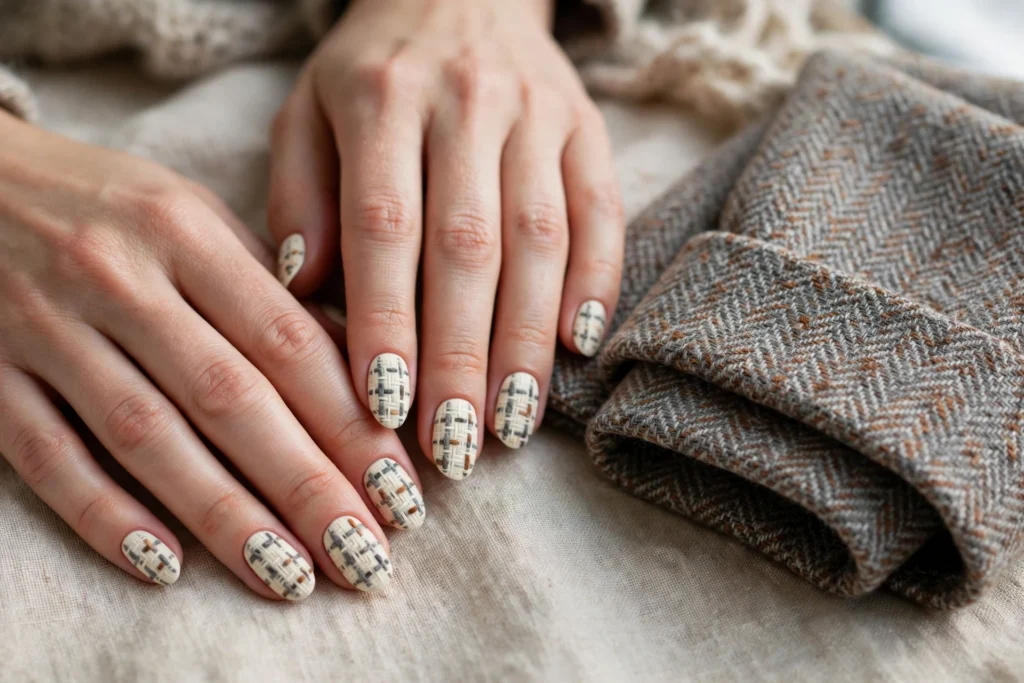
Late winter has a uniform: the good coat, the boots that have seen everything, and — on my nails — tweed. The woven, speckled texture of a tailored jacket, painted in miniature. Tweed nails are the last cosy design of the season in my house, the one that bridges the knitwear months and the first bare-armed days, because the pattern is pure fabric nostalgia.
Jump to section
The method I follow is Miss Jo’s Nail Co.’s easy tweed tutorial, which builds the weave from short broken strokes in layered colours over a soft base. What follows is that layering with my notes on stroke discipline, the matte-versus-gloss decision, and colour stories from boardroom grey to ballet pink.

What you need
A base shade in a soft neutral — cream, stone, blush or pale grey — plus three weaving colours that live happily together, a very fine liner brush, and your choice of matte or glossy top coat. Textured or slightly grainy gel polishes make the weave read even more like cloth, but ordinary polishes work perfectly. The close relative on this site is our sweater-knit nails tutorial: that design is raised cable knit, all loops and rows, while tweed is flat, broken and woven — cousins, not twins.
Tweed is not plaid, either
Since the family resemblance causes real confusion: plaid is long straight lines crossing in a regular grid, with the colour left flat between them. Tweed is hundreds of short dashes — verticals, horizontals and the occasional diagonal — none of them reaching across the nail, in three or four colours plus flecks. If plaid is the tartan scarf, tweed is the jacket: denser, specklier, more forgiving. Our plaid nail art tutorial teaches the grid; this page teaches the weave, and the two techniques share nothing but a liner brush and good posture.
Building the weave, layer by layer
Base first: two coats of your neutral, fully set. Then the warp — with your mid colour, paint short vertical dashes across the nail, each about a third of the nail’s length, spaced unevenly; tweed is irregular and the irregularity is the realism. Set that layer. Next the weft: the second colour, short horizontal dashes crossing the verticals, again broken and uneven. Then the fleck layer: your darkest or brightest colour, tiny single dashes and dots scattered sparsely — this is the thread of contrasting yarn woven through real tweed, and restraint here is everything; twenty flecks is a weave, sixty is a rash. Work nail by nail, and step back often, because tweed judges itself at arm’s length, never at magnifying distance.
Matte or gloss: the fabric question
Matte top coat makes tweed look like actual cloth — soft, fibrous, expensive — and it is the finish I choose nine times in ten. Gloss makes it look like a photograph of cloth: prettier in pictures, less convincing in the hand. There is a third option, the satin or velvet-matte finish, which splits the difference and wears the longest of the three. Whichever you choose, apply it in one confident coat, because a second pass over textured dashes can drag the flecks. The finish discipline here is the same one in our matte nails for autumn guide: thin coat, capped edge, no fussing.
Colour stories
Classic tweed runs on neutrals: cream base, stone and charcoal weave, one thread of rust. Ballet tweed is blush with white and rose dashes and a single gold fleck layer — the softest thing I own. Boardroom tweed is pale grey with navy and white, worn with everything and questioned by no one. And the late-winter special in my house is sage: cream base, sage and olive dashes, flecks of cream-yellow, the first green of the year smuggled into a winter texture. Match the fleck colour to something you actually wear — a scarf, a coat lining — and the manicure looks styled rather than themed.
Keeping texture tidy as it grows out
Broken-pattern designs grow out gracefully because there is no hard motif edge at the cuticle to date the set, which makes tweed a genuinely practical choice for busy weeks. The wear point is the free edge, where dashes chip first; a fresh top coat on day four reseals them. When you remove the set, expect the fleck layer to need a patient soak — the dashes sit in tiny topographical layers and remover needs a minute longer than usual. It is the only fussy moment in the design’s whole life cycle, and it happens with a cup of tea in hand, so I forgive it.
Tweed on short nails and long
On short nails the weave arguably works better: the dash field is smaller, so the texture reads denser and more cloth-like, and three dash layers cover the canvas quickly. Keep the base pale and the flecks sparse, because on a small nail every fleck is a bigger percentage of the story. On long nails, let the pattern breathe — add a fourth, quieter dash colour and leave the occasional gap of bare base showing, like the worn elbow of a beloved jacket. Almond shapes wear tweed most elegantly in my experience, because the weave follows the taper and the whole nail starts to look tailored, which is, after all, the fantasy the design is selling.
Frequently asked questions
Is tweed nail art difficult?
No — it is the most forgiving pattern in this entire batch, because mistakes are indistinguishable from the design. Uneven dashes are not errors; they are the weave. If you can make a short brush stroke, you can make tweed.
Which colours make tweed look most realistic?
Three related neutrals plus one contrasting fleck colour, all in the same temperature family. Cream, stone and charcoal with rust flecks reads as cloth from across a room.
Can I do tweed with regular polish?
Yes. Let each dash layer dry for two full minutes before the next so the strokes stay separate, and use a light hand — regular polish dashes should be painted with the very tip of the brush.